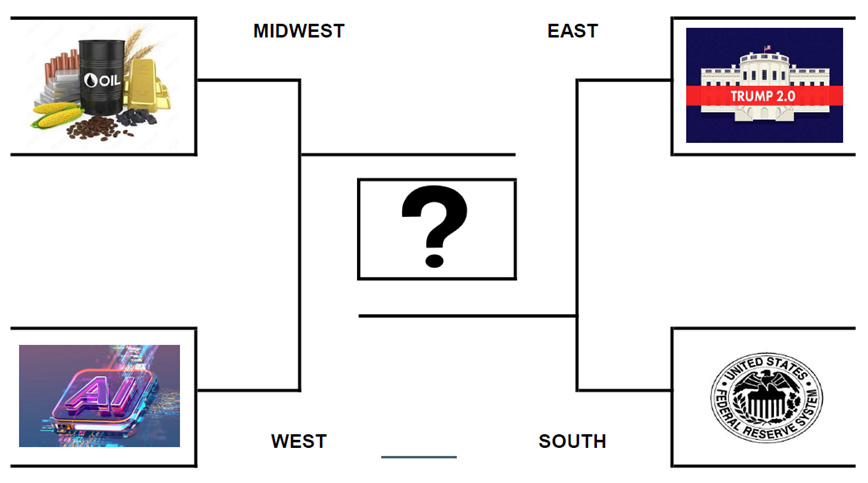
“There are decades when nothing happens, and there are weeks when decades happen.” This quote, sometimes attributed to Vladimir Lenin, seems to appropriately describe the first quarter of 2026. Not that we have been cruising along without bumps here and there, but the “long” period of market stability with double digit upside we have enjoyed over the last three years has certainly given way to some rapid intense changes. Whether it’s war, technological shifts, or Supreme Court rulings, there is no doubt we are experiencing an accelerated history by the transformation of the social, economic, and political landscapes all at once. So, how should investors react and which themes will continue to drive markets for the rest of the year? Let’s take a look at our annual Investor’s Final Four.
Out of the Midwest region, perhaps unsurprisingly, we have a basket of commodities. Those who have invested in gold over the last few years know how consistently good returns have been with a compound annual growth rate of roughly 24% since 2023. However, it’s not the shiny yellow metal that is burning down the nets this year, it’s oil, fertilizer, and other industrial inputs. With the onset of the Iran conflict in early March, crude oil prices have risen from around $70 a barrel to $105. Due to infrastructure damage and war-related closures to the Strait of Hormuz, the global supply of oil has seen a dramatic drop. Accordingly, prices for all kinds of derivatives like gasoline have skyrocketed in the near-term. Interestingly, the price of oil futures looking out to December 2026 are much lower at $76/barrel. This means that the market is currently pricing in a significant resolution to the current disruption. Were this not to happen, it’s safe to say that stock prices and our wallets will reflect the pain. On the flip side, with crude oil spiking, energy companies and their stockholders have been the big, if not only, winners in the first quarter. The S&P 500 Energy Index jumped 38% in the first three months. While we expect them to cool off that torrid pace in the second half, don’t count on a return to pre-war levels as it is not just the supply bottleneck causing their surge. The higher demand for energy to fuel new infrastructure for data centers seems to have legs for the foreseeable future.
Speaking of datacenters, out of the West region we once again have the Artificial Intelligence (AI) theme making a run in our bracket. The so-called “Magnificent 7” stocks of Nvidia, Apple, Amazon, Microsoft, Google, Meta, & Tesla have been the blue bloods of the tournament for three straight years. All of these companies have their hands in the AI boom cycle in many different ways and have led the markets to double digit returns through their sheer size relative to the other 493 stocks in the S&P 500. Now representing about 33% of the index, these companies have gone cold from the field in the first quarter with the Mag 7 down an average of 16%. However, it’s not really anything to do with the fundamentals of the companies, as they continue to show above average earnings growth. What has happened is more of a change in sentiment. These darlings who could do no wrong, now face criticism over excessive debt, circular financing and worries about the scale of future efficiencies. These worries are legitimate, but at the same time, other sectors of the market have sold off specifically because AI was seen as a massive threat to their business models. What is being coined the “SaaS-pocalypse”, was a significant market correction and structural shift in the software-as-a-service (SaaS) industry, accelerated in early 2026 by advances in agentic AI. The core narrative is that AI is moving from a helpful "copilot" to an autonomous agent that can replace human workflows, making expensive, per-seat, general-purpose software subscriptions less necessary and driving down software company valuations. Many software related stocks have fallen 50%, and the contagion has spread to the private credit space where a lot of lenders have made loans to software companies thinking that their asset-lite and high margin businesses were a good credit risk. At this point it’s too early to tell where all the fallout will land, but I’d wager the answer is somewhere in the middle. Yes, Anthropic and other agentic AI companies will likely eliminate the need for certain software in the future, or at the very least, they may compete to lower the gross margins of the product. This may be good for consumers, and it will create new efficiencies for businesses to hopefully pass along savings. Several of the biggest private AI companies (SpaceX, Open AI, Anthropic) are expected to IPO later this year, so don’t expect AI to escape the headlines any time soon.
Out of the South region we once again have the Federal Reserve (Fed) led by Chair Powell on his farewell tour. In his final tournament, Coach Powell will try to thread the needle on monetary policy to keep the economy from getting too hot or too cold. This is a difficult balancing act that was made even more challenging by an executive branch that is dead set on removing him or at least sterilizing any impact he may have prior to his term ending in May. In fact, a new chairman has already been named but not confirmed by Congress yet, and Congress is refusing to vote on a confirmation unless charges of malfeasance against Powell and Fed Governor Cook are dropped. This struggle for Fed independence has definitely had a negative impact on the stock market thus far. Clarity will help, but not if the new Chair, Kevin Warsh, is perceived to be in Trump’s pocket. Whether he is or isn’t is a different debate, but the direction of interest rates is at stake, and rates have been the dominant driver of stock market returns for the last decade. Looser monetary policy has generally led to asset price inflation, while tighter policy portends higher lending costs and slower growth. However, that’s looking at policy in a vacuum, versus what is actually going on in the economy. Right now there is a very delicate balance between a fragile labor market and an inflation rate that is sitting right around 3% (not too hot, but also not at the 2% target rate). While the consensus at the beginning of the year was to expect two interest rate cuts in 2026, the jump in commodity prices associated with the war in Iran has flipped the script to where the street now thinks we may have one hike. Look for the eventual outcome of the interest rate direction to be a huge theme for the remainder of the year.
Last but not least, we have the Trump Administration 2.0 coming out of the East region. With their fingers in every part of the themes we have already discussed, it’s pretty clear that they are the juggernaut of market themes so far in 2026. This should come as no surprise as we have seen this movie before in the first administration and again more recently with the onset of the Liberation Day tariffs. Starting on April 2nd 2025, the initial shock of the announcement led to a near 20% decline in the markets, which I would note, was more than reversed by year end with the S&P 500 closing higher by 16%. With another negative 1st quarter in the books, one does not necessarily need to draw a dour conclusion. If nothing else, Trump 2.0 is unconventional compared to past executive administrations. The speed and methods of change are unique and create a lot of uncertainty in the short run. Generally, the stock market reacts negatively when investors don’t have visibility to predict corporate earnings because the policies aren’t clear or other geopolitical disturbances create ambiguity. Thus, Trump’s battle with Fed independence, or war with Iran, or even the constitutionality of his tariff policy can create distortions. However, in the medium to longer term, his policies on lower taxes, deregulation, and push for a lower interest rate may benefit stock prices. Keep in mind that the lower tax rates and extra deductions for 2025 from the One Big Beautiful Bill Act (OBBBA) still haven’t manifested into the economy, and now that the Supreme Court ruled his Administration’s use of the IEEPA clause to justify tariffs by executive order was overturned, how might those hundred billion plus dollars flowing back into the economy help consumer spending and economic growth? If the conflict in Iran comes to a quicker than expected resolution, what might the price of oil look like years down the road with a friendlier group of gulf countries aligned with the US?
The only thing that is certain is that Trump 2.0 will continue to be unpredictable. Heck, they are even trying to change the college sports scene by executive order, which is kind of ironic, don’t you think? Name, Image, and Likeness (NIL) has upended amateur athletics and led to massive changes like the transfer portal that make the end product look almost unrecognizable from a few years ago. Yet, Trump just announced for the first time in our nation’s history that his signature will be on our currency. No sitting President in our 250 year history has done that kind of NIL.
Here’s hoping that the stock market responds like ticket prices and streaming subscriptions have in the new era of college sports and continue going up up up! Whether you’re watching from home or sitting courtside, this year’s “Investment Big Dance” is a must watch entertainment.